This Studapart SEO analysis evaluates the platform’s organic visibility, keyword positioning, technical structure, and overall search performance.
Studapart is a French digital platform specializing in accommodation for students and young professionals. It offers verified listings such as studios, shared apartments, and student residences and along with that Its business model focuses on simplifying access to housing for students, especially international ones, through secure listings and dedicated support services as well. Actually, from an SEO perspective, Studapart has absolutely developed strong visibility in high-intent queries related to housing, particularly those linked to student accommodation in major French cities.
Semrush Studapart SEO analysis
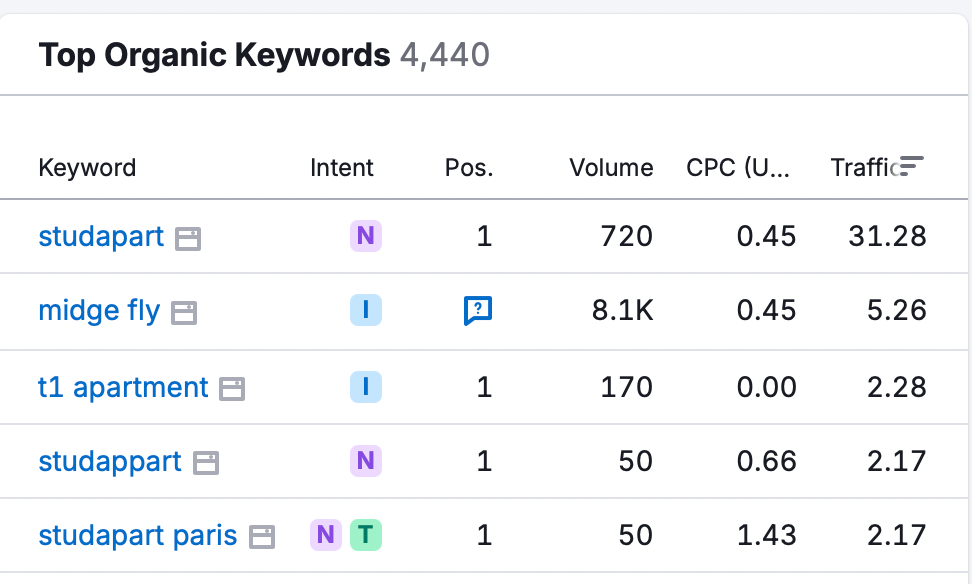
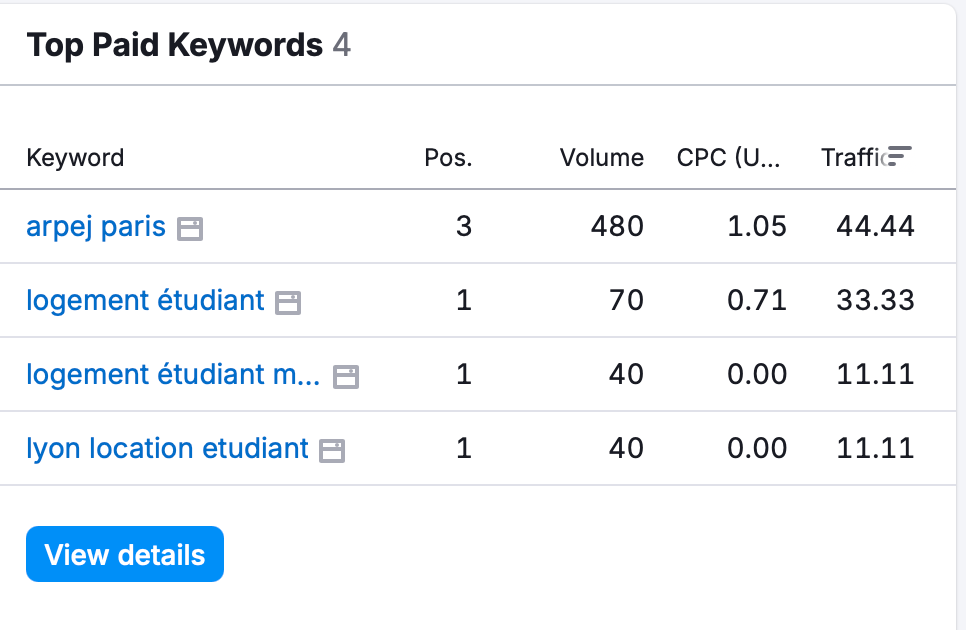
Top 10 Keywords
- studapart
- midge fly
- t1 apartment
- studappart
- studapart paris
- apt 2h
- what is a studio
- t3 apartment
- apt 244
- apartment student
Keyword Intent Analysis
Studapart strongly aligns its keyword portfolio with:
- Branded queries (e.g., “Studapart”) – Navigational intent
- Transactional queries (e.g., “logement étudiant Paris”) – High conversion potential
- Informational queries (e.g., “what is a studio”) – Top-of-funnel acquisition
This indicates a full-funnel SEO strategy.
SERP position:
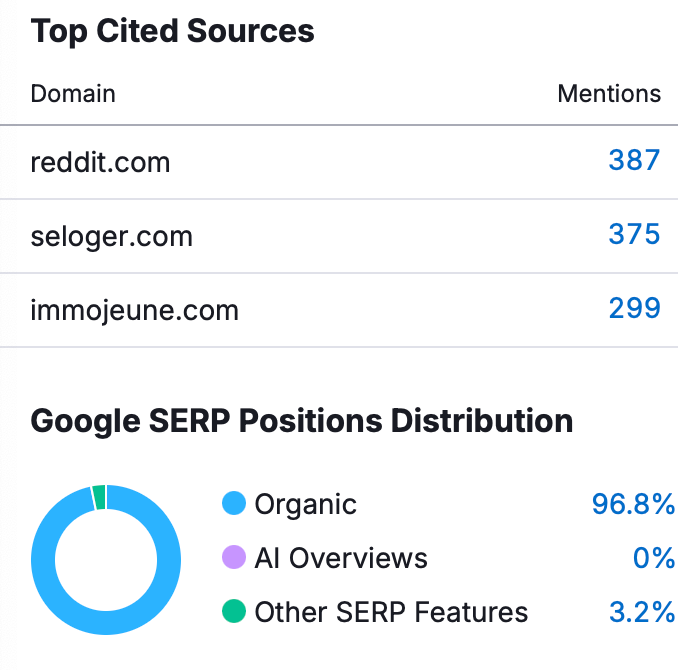
Studapart SEO Analysis: Organic Performance Overview
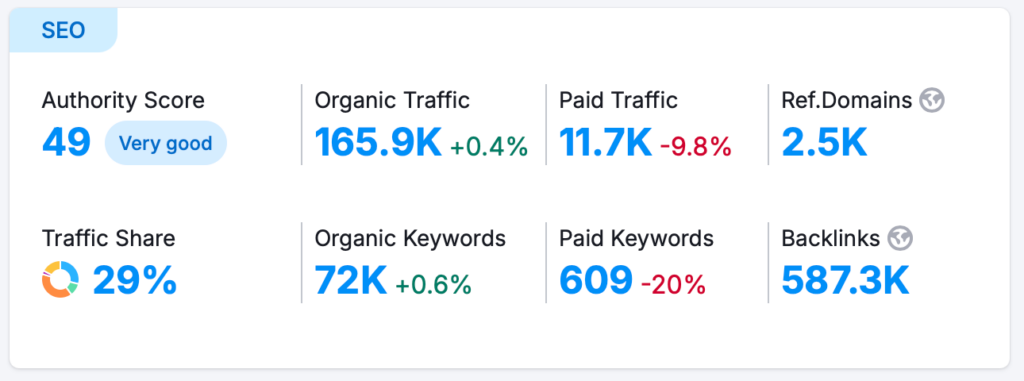
Studapart ranks organically for approximately 71.8K keywords, indicating a very strong organic footprint within the student accommodation and real estate market in France.
Keyword Position Distribution
- Strong presence in the Top 3 positions, especially for brand and transactional keywords.
- Broad and stable base in positions 4–10.
- Growth potential in positions 11–50.
This reflects a mature SEO strategy with both:
- Defensive positioning (brand protection)
- Offensive positioning (capturing generic, high-intent keywords)
SERP Feature Visibility
What CTR means?
Click-Through Rate (CTR) measures the percentage of users who click on a result after seeing it in Google. It strongly influences:
- Ranking position
- SERP features (Local Pack, AI Overviews, rich snippets)
- Brand recognition
Because Studapart ranks in the Top 3 for many branded and transactional queries, its organic CTR is likely significantly above average.
When a domain appears multiple times in SERP features, it increases visual dominance, which psychologically reinforces trust and boosts click probability.
For the Studapart SEO analysis, this means te company is not only ranking well but it is maximizing traffic capture efficiency.
The platform benefits from high visibility in multiple SERP features, including People Also Ask, Local Pack, Image Pack, AI Overviews, and also rich elements. This enhances click-through rate (CTR) and brand credibility, especially in competitive student housing searches. Keyword trends show stability, with seasonal peaks aligned with the academic calendar.
Traffic & SEO Efficiency
- Estimated organic traffic: ~14.5K visits per month
- Traffic cost equivalent: approximately $3.5K
The high proportion of keywords in the Top 10 allows Studapart to achieve strong organic CTR, particularly for:
- Brand queries (e.g., “Studapart”, “Studapart Paris”)
- Transactional searches (e.g., “logement étudiant Paris”)
This confirms that SEO functions as an efficient and strategic acquisition channel for the platform.
Backlink Profile & Toxicity Breakdown
The backlink profile includes 6.9K total backlinks (86.4% follow) from 2.4K referring domains (83.4% follow), with 195 new, 152 broken, and 295 lost links. Overall toxicity is high, with 677 high-risk backlinks (27.8%), 155 potentially toxic (6.4%), and 1.6K non-toxic (65.8%). Despite a high level of toxic backlinks, the site maintains its rankings, suggesting that the link-building strategy remains mostly safe and sustainable.
Domain Authority and Market Position
Studapart has an authority score of 49. Considering the high keyword volume, medium competitive difficulty, and strong SERP presence, it maintains medium-high domain authority and high trust, reinforced by brand searches, institutional partnerships, and verified listings.
Strategic Takeaways
The platform dominates brand searches and captures generic student accommodation keywords, with strong visibility in Paris and other major student cities. Its presence in SERP features boosts CTR and credibility, and its SEO strategy supports long-term growth and trust consolidation.
Conclusion
Overall, the Studapart SEO analysis shows that Studapart performs strongly as an SEO competitor in the French market for student and young professional accommodation. With 71.8K ranked keywords, strong Top 10 presence, stable traffic, and a solid backlink profile (though some toxicity to monitor), it would be a strong competitor to HabiFrance and sets a high benchmark for any platform aiming to enter or expand in this segment.
SCREAMING FROG ANALYSIS
The Screaming Frog crawl identified a range of SEO issues categorized as Issues, Warnings, and Opportunities, with varying priority levels (High, Medium, Low). These findings highlight areas where the website could improve its technical structure, on-page optimization, and security.
High-Priority Issues
Pagination: Pagination URL Not in Anchor Tag (86 URLs – High Priority Issue)
Pagination URLs are not implemented using anchor (<a>) tags. This is an issue because search engines rely on anchor tags to crawl and understand page relationships. Without them, search engines may not crawl or index paginated content correctly. This can be fixed by ensuring all pagination links are coded using proper <a href=””> anchor tags.
Directives: Noindex (5 URLs – High Priority Warning)
Some pages include a noindex directive. This is an issue, pages marked as no index will not appear in search engine results, which may reduce visibility if these pages are important. You can fix this by reviewing each no-indexed URL and removing the directive from pages that should be indexed.
Response Codes: Internal Client Error (4xx) (6 URLs – High Priority Issue)
Several internal URLs return 4xx client errors.
This is an issue because these errors prevent users and search engines from accessing content, negatively affecting user experience and crawlability. This can be fixed by updating or removeing broken links and ensure all internal URLs return a valid 200 status code.
Directives: Nofollow (5 URLs – High Priority Warning)
Some pages contain a nofollow directive. This is an issue because this prevents search engines from following links on these pages, limiting link equity distribution. Fix this issue by updating or removing broken links and ensuring all internal URLs return a valid 200 status code.
Response Codes: Internal Blocked by Robots.txt (5 URLs – High Priority Warning)
“The robots.txt file blocks some internal pages, preventing search engines from crawling them and potentially stopping valuable content from being indexed. Fix this issue by reviewing the robots.txt rules to ensure only non-essential pages are blocked.
Hreflang Issues (High Priority Issues)
- Non-200 hreflang URLs (1 URL)
- Noindex return links (1 URL)
- Noindex return links / Missing self-reference
This is an issue because Incorrect hreflang implementation can cause search engines to ignore language or regional targeting. This can be fixed by ensuring all hreflang URLs return a 200 status code and point to indexable pages with proper self-referencing tags.
Canonicals: Canonicalised (13 URLs – High Priority Warning)
Some pages use canonical tags pointing to other URLs, which may cause search engines to ignore them in favor of the canonical version and potentially reduce rankings. Fix this issue by reviewing canonical tags to ensure they point to the correct preferred URLs.
Medium-Priority Issues
Page Titles Too Short or Too Long
- Below 30 characters (8 URLs)
- Over 60 characters / Over 561 pixels (43 and 29 URLs)
- Duplicate page titles (4 URLs)
This is an issue because Improper title length or duplication reduces keyword relevance and may impact click-through rates. This can be fixed by writing unique, descriptive titles within recommended character and pixel limits.
H1 Issues
- Missing H1s (7 URLs)
- H1 over 70 characters (5 URLs)
- Duplicate H1s (4 URLs)
This is an issue because H1 tags help search engines understand the main topic of a page. Missing or poorly optimized H1s reduce clarity. This can be fixed by ensuring each page has one clear, unique, and appropriately sized H1.
Content: Low Content Pages (11 URLs – Medium Priority Opportunity)
Some pages have low word counts. This is an issue because thin content may struggle to rank and provide limited value to users. This can be fixed by expanding content with relevant, informative text.
Images Over 100 KB (3 URLs – Medium Priority Opportunity)
Some images exceed recommended file size. This is an issue because large images can slow down page load speed. This can be fixed by compressing images while maintaining quality.
Low-Priority Issues
Heading Structure Issues
- H2 Non-Sequential (262 URLs)
- H2 Duplicate (263 URLs)
- H2 Multiple (150 URLs)
- H2 Missing (3 URLs)
This is an issue because poor heading structure affects accessibility and makes it harder for search engines to understand content hierarchy. Fix this issue by ensuring headings follow a logical order (H1 → H2 → H3) and are unique where appropriate.
Meta Description Issues
- Missing meta descriptions (15 URLs)
- Duplicate meta descriptions (4 URLs)
- Over 155 characters / over 985 pixels (73+ URLs)
This is an issue because Meta descriptions influence how pages appear in search results and affect click-through rates. This can. be fixed by creating unique, concise meta descriptions within recommended limits.
Image Optimization Issues
- Missing alt attributes (48 URLs)
- Missing image size attributes (16 URLs)
This is an issue because negatively affects accessibility and page performance. This can be fixed by adding descriptive alt text and define image dimensions.
Security Header Issues (Very High Volume)
Large numbers of URLs are missing:
- HSTS headers (429 URLs)
- Content-Security-Policy headers (429 URLs)
- Secure Referrer-Policy headers (429 URLs)
- X-Frame-Options headers (428 URLs)
- X-Content-Type-Options headers (366 URLs)
This is an issue because missing security headers increase vulnerability to security risks and reduce browser trust. This can be fixed by Implementing appropriate HTTP security headers site-wide.
Conclusion
In conclusion, the Screaming Frog analysis shows that there are several technical and on-page SEO issues that need attention. The high-priority problems like pagination errors, 4xx codes, incorrect directives, hreflang issues, and canonicals should be fixed first because they directly impact how search engines crawl and index the site. After that, improving titles, headings, content, images, and security headers will help strengthen the website’s overall SEO performance.