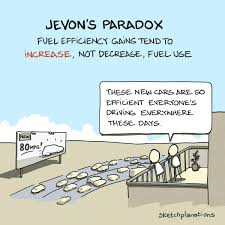
The history of technology follows a recurring pattern: each breakthrough promises efficiency but also triggers a rise in energy consumption. From the steam engine to artificial intelligence, the same mechanism repeats itself. The Jevons paradox explains this counterintuitive principle: efficiency gains ultimately lead to increased resource consumption rather than savings. Baptiste Jeauneau draws a parallel between these revolutions to break down this phenomenon.
Massive Investment and the Quest for Energy Efficiency
The scale of investment in artificial intelligence is staggering. Tech giants are pouring billions into data centers, GPU clusters, and model training. Each generation of AI models demands more computational power, and with it, more energy. While engineers work tirelessly to optimize algorithms and reduce the cost per inference, the overall energy footprint keeps growing — a textbook illustration of the Jevons paradox in action.
As efficiency improves, the cost of using AI drops — making it accessible to more industries and more users. This accessibility fuels demand at an exponential rate. Companies that once could not afford AI now integrate it into every workflow. The result is a net increase in total energy consumption, even as each individual task requires fewer resources. The quest for efficiency, paradoxically, accelerates the very problem it aims to solve.
New Talents Emerge When Social Value Shifts
Within this framework of redefinition, humans remain the ones who trigger action. An idea is worthless; it is execution that matters. Aristotle defined intelligence as the ability to use tools: humans are superior because they possess the hand, a multi-purpose tool. By creating AI, we are building a new multi-purpose tool that redefines the social value of intelligence itself.
The expected skill sets are shifting: organisations now need profiles with an architect’s vision rather than an engineer’s. Talents once overlooked are emerging because the window of competencies has moved towards new intellectual criteria.
The Jevons Paradox According to Baptiste Jeauneau
The FOMO Effect and Mass Adoption
The combination of investment and talent acquisition creates traction that captures everyone’s attention. Each person, witnessing this momentum, may experience the fear of missing out (FOMO). Baptiste Jeauneau observes that this forced integration pushes people to seek use cases for AI even when they are not necessary, amplifying the Jevons paradox at scale.
Unplanned Consumption
By optimising a technology to make it more efficient, we also generate broader interest in it. What follows is usage across applications that were never originally intended, and therefore additional, unplanned consumption. What was supposed to make us consume less has ultimately increased our consumption. This is precisely the Jevons paradox: efficiency does not reduce demand, it multiplies it.
The Ecological Question: Finite or Infinite Resources ?
This rise in consumption raises a fundamental question: can innovation lead to our downfall?
If the resources required by these technologies are finite, then every optimisation that generates new use cases brings us closer to a breaking point. If they are infinite, as some Silicon Valley figures, including the current CEO of Y Combinator, argue, then the Jevons paradox is merely an accelerator of progress.
Baptiste Jeauneau notes that everything depends on how we define our resources. The answer to this debate shapes whether the Jevons paradox is a warning or simply a feature of human advancement.
Related reading: Analysis of AI in Football | AI Music Discovery and Emotions
Conclusion
Human creativity always finds new use cases for every optimised technology. Baptiste Jeauneau shows through this parallel that investment and the emergence of new talents, however positive they may be, fuel a cycle where efficiency generates even more consumption. Understanding the Jevons paradox is essential for anyone interested in the real impact of innovation on our world and its resources. Discover more perspectives from our Group 2 Paris contributors, including Margarita and the quiet habit of collecting ideas.